


Flugplatz Brandis (1934–1943)
The Flugplatz Brandis, 20km east of Leipzig, was built between 1934 and 1936 during the first wave of Nazi Luftwaffe rearmament. Designated as the “Blindflugschule 1”, it was set up to train Luftwaffe pilots how to fly using only their flight instruments. In the mid 1920s, Luftwaffe pilots had secretly been receiving training in civilian flight schools set up by the DVS, but those had become obsolete by 1934, when the Nazis established 12 “Blindflugschulen” throughout Germany and german held territories.


Upon its construction, the Flugplatz Brandis (Codename Bickbeere -> blueberry) consisted of four aircraft hangars (though 6 had been planned), a maintenance hangar, several transformer bunkers, a switchboard, a fire station and of course the obligatory command structures, barracks, officers casino, and a parachute packing building. Like the majority of early airbases, Brandis was initially “only” equipped with a 1400m long grass runway.

The first officially documented use of the Fliegerhorst Brandis dates to October 1935, when the “Fliegerlehrgang 1” moved in to begin with its training. By the end of December 1936, the Fliegerhorst Brandis was officially designated as “Blindflugschule Brandis” – though as was typical for many of these Airbases, the name changed again in early 1940, when it was changed to “Blindflugschule 1” and again in October 1943 to “Flugzeugführerschule B 31”.


The Dessau based aircraft manufacturer Junkers A.G – responsible for building the JU 87 (aka Stuka) and JU 88 – used the Flugplatz Brandis Waldpolenz as a testing site, something which will become very relevant down the line. Prototypes of the Junkers JU 287 (a multi-engine tactical jet bomber), the Henschel Hs 130 ( high-altitude reconnaissance and bomber) as well as the Horten Ho 229 (the first jet powered flying wing aircraft) were tested in Brandis, with a HO 229 squadron having been planned to be stationed in Brandis at some point during the war.
In addition to being used as a Blindflugschule, the Luftwaffe established the Weather Reconnaissance Squadron WeKuSta 1 in Brandis. As with many other Luftwaffe Airfields, Brandis saw a relatively large rotation of units – the most notable being:
- Wettererkundungsstaffel 1 (Wekusta 1)
- Jagdgeschwader 37 and Jagdgeschwader 38
- Ergänzungs-Aufklärungsgruppe (F) Ob.d.L.
- IV./Nachtjagdgeschwader 5
- I./Kampfgeschwader 1 „Hindenburg”
- 9./Nachtjagdgeschwader 5
- I./Jagdgeschwader 400
Sack AS-6, the Flying Beer Mat (1938–1945)
In 1938, the farmer and self taught aircraft designer Arthur Sack, designed and built a circular winged aircraft – the AS-1. He constructed 6 prototypes, and entered one of them in a Nazi sponsored national contest for Motorised Flying Models in July of 1939 in Leipzig. The model aircraft couldn’t take off by itself, but proved to be capable of flying (though its handling capabilities were extremely poor). The fighter ace Ernst Udet, now director for research and development of the Luftwaffe, was present at the show and fascinated by the AS-1. Under encouragement of Udet, Sack would continue to develop the concept of the round wing aircraft.

By February of 1944, the Mitteldeutsche Motorenwerke in Leipzig (a subsidiary of the Auto Union – now known as Audi) produced the 6th version of the AS-1, now known as the AS-6 V1, the first manned prototype. The Sack AS-6 V1 was shipped off to Brandis Waldpolenz where the final assembly took place. The plane had multiple issues – but neither Sack nor the other engineers could agree to what the main issue was preventing the aircraft from achieving lift off. In the end, the combination of an underpowered motor and poor angle of attack caused the Sack AS-6 V1 to flunk its first 5 test runs.
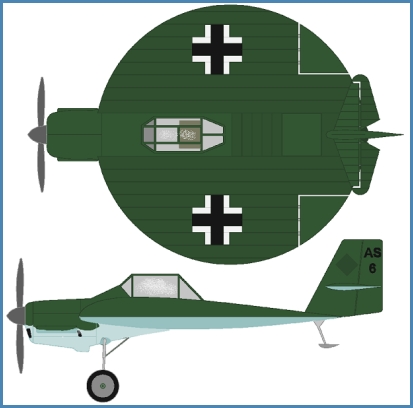
On April 16, 1944, the AS-6 V1, modified for improved flight capability, made multiple attempts to take off but faced repeated failures due to stability issues attributed to the torque from its As 10C-3 engine. Despite several tries, problems with stability led to the collapse of a landing gear leg, prompting the engineers to advise Sack to halt further flight tests until the aircraft could undergo wind tunnel testing and necessary modifications.


In the summer of 1944, as the Jagdgeschwader 400 moved to Brandis and began flying the advanced Messerschmitt Me 163B Komet, Sack saw an opportunity to test his modified AS-6, now nicknamed “Bussard” (Buzzard), with more skilled pilots. Bemused by the aircraft’s circular shape, the Pilots dubbed the Sack AS-6 “der fliegende Bierdeckel” – or the flying beer mat.


Despite a new test pilot, Oberleutnant Franz Roszle, taking the controls, the aircraft once again failed to maintain flight and suffered gear collapse. Roszle recommended that Sack’s design be forwarded to Messerschmitt for further development, which led to the proposal of an improved version, the AS-7 or Me 600. However, before any further progress could be made, the AS-6 was destroyed during a strafing run by the US Airforce, and by April 1945, with the arrival of US troops at Brandis, all physical evidence of the AS-6 had vanished.
Based on its size and shape – one could theorise that this thing was partially responsible for the Nazi UFO craze that would crop up several decades later. If the story of the Sack AS-6 seems vaguely familiar – then it could probably be that you’ve seen the 1965 movie (or 2004 version) “The Flight of the Phoenix“, where a cargo plane crashes in the Libyan desert, and the surviving crew – under the direction of a german aircraft engineer – build a new plane. The kicker being that the german aircraft engineer only ever had experience building model airplanes. Quite the coincidence.
Flugplatz Brandis Waldpolenz Video
This time around, we did a rather extensive walk around through what’s left of the Brandis Airfield. This video is slightly longer than what we normally do, but we decided to include almost all of the footage that we took during our last visit.
The Luftwaffe “Silberprogramm” (1941–1945)
With the development of the first jet powered aircraft like the Messerschmitt Me 163, Arado Ar 234 and the Messerschmitt Me 262 between 1941 and 1943 – the Luftwaffe realised it needed “upgrade” its airbases with long enough concrete runways. The majority of its airbases either only had grass runways or their existing runways were simply too short to accommodate these new aircraft models.


Under the Codename “Silberprogramm” (Silver Program), the Luftwaffe sought to modernise (and to a certain extent build new) over 90 of their airbases and extended their concrete runways to a minimum length of 1700m up to 3000m. While the majority of projects were never completed, the Flugplatz Brandis Waldpolenz was one of the few that were actually successfully extended – it now had a 1800m long concrete runway – and saw the deployment of a fully operational unit – the 1./Jagdgeschwader 400 and later on the 3./Jagdgeschwader 400.


Formed on the first of February 1944 in Brandis, the Jagdgeschwader 400 was the first and only unit to be formed and equipped to specifically fly the Messerschmitt Me 163. The Me 163 Komet (also dubbed “Kraftei”) was the first piloted aircraft to surpass speeds over 1000kph, and would hold the record (1139kph) up until 1953.


The Jagdgeschwader 400 was stationed specifically in Brandis, as it was on a strategic allied bomber route – which the Nazis hoped to disrupt with their rocket powered aircraft. Coincidentally, it was the pilots of the Jagdgeschwader 400 which had helped Arthur Sack test his AS-6. Ultimately, the Jagdgeschwader 400 with its Messerschmitt Me 163 proved to be too little too late.
Flugplatz Brandis (1943–1945)
Brandis Waldpolenz was bombed several times between 1944 and 1945 by the US Airforce, with one of the hangars being completely destroyed. This did not deter the germans from expanding the existing infrastructure, building new assembly halls and hangars for the Messerschmitt Me 163. The Germans began evacuating the Fliegerhorst in early April 1945, with the advancing American Troops capturing it on the 16th of April 1945.


The Americans ultimately handed over the Flugplatz Brandis Waldpolenz to the Soviets on the 7th of July 1945 (making sure to take anything technologically relevant with them) – as it had been agreed during the Yalta Conference that Saxony would fall under the Soviet Occupation Zone.
Flugplatz Brandis (1945–1992)
Now under Soviet operation, the Flugplatz Brandis received a new russian codename “КАБИНКА” (Cabin), which was later changed to “ЗАПАЙКА” (Soldering Point). The runway was initially kept at the length that the Soviets had found it in, but was expanded to 2200m by the early 1960s.


Between the late 1940s and late 1950s, Brandis was used primarily as a diversion facility, but hosted a series of Jak-9, MiG-15, MiG-17, MiG-19 and Il-28 units. By the 1960s, Brandis was turned into a Helicopter base with Mil Mi-4, Mi-6 and Mi-10 models, with even the lesser known Mi-10PP variant being stationed there (designed for electronic warfare) as well.
Between the 1950s and the late 1980s, the Soviets continuously remodelled the airbase – primarily adding infrastructure for their aircraft. The majority of the buildings built by the Nazis in the 1930s had survived and continued to serve their purpose for their new landlords, so the Soviets built comparatively little new buildings (aside from garages and bunkers). One of the larger administrative buildings was seemingly converted into a Hospital.


With the signing of the 2+4 Treaty and German reunification (and a lot of financial “assistance” from Germany) – the former Soviet troops began withdrawing from a now unified Germany. The Russian troops began demolishing parts of the airbase in early 1992, and by April 1992, military equipment was being shipped back to Russia. The last transport flights out of Brandis were by an Antonov An-12 and an Il-76 transport plane. The property was officially handed over back to the German state on the 30th of July 1992.
Flugplatz Brandis (1994–2014)
The German authorities continued some of the demolition work that the Soviets had started, but left most of the airbase infrastructure intact. Brandis was still certified to be used as a civilian airport, and was subsequently rented out to a private investor in 1994. Both a flight school and an “Air Taxi” service (aka a private helicopter service) operated from Brandis – though Brandis ultimately ceased its operations as an airport in 2005.


Between 2007 and 2009, the German company juwi Solar decided to build the world’s largest solar farm on 110 hectares of the Flugplatz Brandis. The solar farm went online in 2009 and was the largest of its kind in Germany, and “only” the second largest in the world. The solar field was expanded again in 2011 and currently has the capacity to provide power to over 15,000 homes. A Biogas Plant was also built next to the solar farm between 2012 and 2013.
Flugplatz Brandis (2014–2024)
The municipality which owns the Flugplatz Brandis began demolition work again in 2014, and has continuously expressed the wish to demolish all buildings on the property. Due to its historic nature, preservationists have lobbied continuously to save as much as possible of the original 1930s airfield – with little success. 115 hectares of the 360 hectare large property had already been demolished and converted, and in 2014 another 4 buildings were torn down.


The demolition work continued successively over the next few years, with the large patches of the property being reforested. Supposedly some of the buildings had been placed under monument protection during this time – the airport tower and one of the aircraft hangars being two examples – but we’ve not seen any evidence that this has been the case
Flugplatz Brandis Today (2024)
We’ve visited Flugplatz Brandis twice in one year, and not much had changed during those visits. As of 2024, three of the aircraft hangars have survived and roughly a dozen other buildings. Entering/climbing up the tower is something we can’t recommend unless you wish to crash through the ceiling.


The drab east german prefab buildings are the same that you would find across East Germany and in so many other countless abandoned soviet military bases. They’ve all been gutted and only serve as a bleak reminder that even the higher ranking soldiers had a comparatively sparse living quarters. The only building that’s still in more or less “good” condition is the one that was previously used as a hospital/infirmary – though even that one has been smashed to bits.


If you follow the overgrown path through the dense trees long enough, you’ll stumble across a long forgotten Lenin monument. While it’s not been torn down it has been vandalised with graffiti over the years – though some “enthusiasts” have cleaned it. Overall, there are but only a few interesting sights to be seen (if you are fond of bunkers, there’s plenty hidden around the property). It’s a rather sad state of affairs considering the aeronautic history that was made here, but Flugplatz Brandis fate is sealed. It’s a given that over the next few years the entire complex will be demolished.
Flugplatz Brandis Waldpolenz
Address: Am Alten Flugplatz, 04821 Brandis
Geo Coordinates: 51.334224, 12.644580


