


Berlin is one of those cities, that no matter where you go, you’ll stumble across a memorial, plaque or statue of someone or something. One could be forgiven for just giving them a passing glance, but a giant lion statue – especially the “Flensburger Löwe” (Lion of Flensburg) deserves a closer inspection.
The First Schleswig War
Every good memorial needs a back story, and the Lions story begins in 1848 with the first Schleswig war. Through a typically complex set of treaties and inheritances, the Duchies of Schleswig, Holstein and Lauenburg technically belonged to the Kingdom of Denmark and the German Confederation, but was ruled over by the King of Denmark in a personal union (aka when a single monarch rules two or more states while their boundaries, laws, and interests remain distinct).
Tensions arose in 1848, when the King of Denmark, Frederik VII, essentially sought to integrate Schleswig into the Kingdom of Denmark. The ethnic german population (which made up the majority of Schleswig, Holstein and Lauenburg – as well as a total of 1/3 of the population of Denmark) were not keen on this and began an uprising, forming their own provisional government and army – supported by the German Confederation. With the threat of losing the Duchies (and half of the economic output of Denmark), war broke out between the Kingdom of Denmark (supported by the Russian Empire, the United Kingdom, Sweden/Norway and France) and the German Confederation, lasting from 1848 to 1852.

One of the decisive battles occurred on the 25th of July, 1850 near the village of Isted. The Battle of Isted was the largest in Scandinavian history (at the time) and ended in a Danish victory – though it failed to break the Schlesiwg-Holstein army and thus the war continued.
The German Confederation lost the war in 1851 (partially helped by considerable political pressure from the UK and Russia) – and the London Protocol of 1852 settled the matter by confirming the Danish king to be the duke of the duchies but also declaring that the duchies had to remain independent from Denmark proper.
The Isted Lion (Istedløven)
The danish sculptor Herman Wilhelm Bissen, one of the most important danish sculptors – was tasked in 1859 with creating a memorial, commemorating the danish victory at Isted. Bissen sculpted a two ton bronze lion atop a stone plinth – a nod to the lions on the Danish Coat of Arms, as well as the lions on the Coat of Arms of Schleswig and the city of Flensburg
The stone plinth was decorated with the portraits of the danish generals Christopher von Krogh, Friderich Adolph Schleppegrell and Hans Helgesen as well Colonel Frederik Læssøe. The back of the memorial had a verse by the danish poet Carl Ploug inscribed into it.
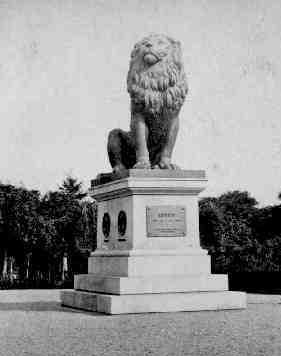
The Isted Lion was unveiled on the 12th anniversary of the Battle of Isted in 1862 in the old cemetery of Flensburg. Some sources say the spot was picked because it supposedly contained the graves of both German and Danish soldiers (though it seems like no Danes were buried there) – but to make space for the monument, over 200 german graves were destroyed. Memorial plaques were erected for the Danish soldiers, while the german plaques were destroyed – and a memorial for germans who died at the Battle of Bov was removed and buried.
To say that the residents of Flensburg were not a fan of the monument would be an understatement. It is also worth pointing out that even the Danes were split on what to make of the Lion, with the Danish King Christian IX rejecting an invitation to its unveiling.
The Second Schleswig War
A mere 2 years after the Isted Lion was unveiled in Flensburg, a succession crisis in Denmark sparked war in Europe. The Danish king Frederik VII had died in 1863 without a suitable heir, causing a European power struggle as to which royal branch would take Frederiks place. At the same time Danish politics had been trying to undertake steps to integrate Schleswig more into the Danish Kingdom. In 1864, the new Danish King, Christian IX approved the so called “November Constitution”, violating the London Protocol of 1852, giving the German Confederation – and specifically Prussia – a valid reason to solve the situation in its favour.
Otto von Bismarck, Minister President of Prussia since 1862, saw an opportunity to make a move. He had managed to form an alliance with Austria, while France was busy with its colonial project in Mexico. Even Great Britain was not to keen to intervene as the Danes had violated the agreement.

Prussian and Austrian troops marched into Schleswig on the 1st of February 1864, kicking of the second Schleswig War – an act which the German Confederation deemed as illegal. By June 1864, the Prussians and Austrians had attained successive victories – though multiple peace negotiations had failed as the parties could to agree on the future southern border of the Danish Kingdom. On the 29th of June 1864, the Prussians took the Island of Alsen – which led the Danes to call for an armistice. With the Danish defeated, the war officially ended on the 30th of October 1864 with the Treaty of Vienna. The result was that the Duchies of Schleswig, Holstein and Lauenburg would be ceeded to Prussia and Austria.
The Flensburg Lion moves to Berlin
On the 28th of February 1864 (or on the 22nd of February depending which source you take), so during the first month of the war, a group of Flensburger tried to topple the hated lion, but only managed to break of its tail and slightly move it from its resting position, after which the group was arrested. After the Prussians gained full control of Schleswig-Holstein, the authorities – under order of Bismarck – moved the Lion into storage. In 1867, General Field Marshal Friedrich Graf von Wrangel (who initial had the supreme command of the prussian troops at the beginning of the Second Schleswig War) ordered that the Isted Lion be moved to Berlin.

This move essentially turned the Lion into an nationalistic symbol for the Danes, symbolising the loss of the “Danish” territories – and thus making it far more popular than it had been before the war. The Isted Lion was (re)unveiled in the courtyard of the Berliner Zeughaus on the 9th of February 1868, and was then moved to the courtyard of the Royal Prussian Main Cadet Institute in April of the same year as a memorial to those who gave their lives in the first Schleswig war. The Isted Lion would stay here until 1945.
The Wannsee – Flensburger Löwe
The second Schleswig war (which is also the reason why the Siegessäule in Berlin was built) and the wars against France and Austria as part of the Wars of Unification were an immensely important point of pride for the Prussian. Many streets and districts in Berlin to this day are still named in relation to the wars, especially in the district of Zehlendorf which has the neighbourhood of “Düppel” – named after the Battle of Düppel, which was won by Prince Friedrich Karl (who also fought against the French at the Battle of Mars-la-Tour) who owned the land in Berlin.

In 1870, the wealthy merchant Wilhelm Conrad built himself a luxurious villa on the banks of the Wannsee, and appropriately named it “Villa Alsen” – after the island that the Prussians had captured in 1864 which led to the Danish seeking peace. The Battle of Düppel had been the prerequisite for capturing Alsen, and seeing as Düppel was now the neighbouring district to Conrads Villa, it only made patriotic sense to name it Alsen. Of course it didnt hurt that Conrads brother in law was Louis Napoleon von Colomier (who also has a street named after him in the area), an Artillery General who took part in the Battle of Düppel, who seemingly mentioned that the view around the Wannsee reminded him of Alsen.


More and more villas popped up around the Villa Alsen, and after Conrads request, the district granted the little colony the name Villa Alsen. In honor of his famous neighbour the Prince, and in an act of patriotic duty – Conrad commissioned a zink copy of the (relatively) nearby Flensburger Lion in 1874, with a relief of Prince Friedrich Karl in the plinth. The Flensburger Löwe was placed atop a small hill and the street was renamed to the aptly “Straße zum Löwen” (Street to the Lion).
After the death of Conrad in the early 1920s, the colony around the Villa Alsen was split up and developed. The Property where the Flensburger Löwe fell into the hands of the city and was fell into neglect and somewhat obscurity. In 1938, the Danes sent an official complaint about the condition of the overgrown and neglected Lion, which prompted the city to move it to a small overlook at the banks of the Wannsee, where it stands to this day.

The plaque of Prince Friedrich Karl at the base of the Flensburger Löwe was stolen during the revolutionary chaos in 1919, but the statue itself was restored in 2005. A new plaque was added to the base of the plinth, adding some context to its (original origins).
The Isted Lion returns to Denmark… and Flensburg
The Danes didnt forget about the original Isted Lion, and after the end of the second world war – sent a request to the American Authorities to return the Lion to Denkmark. Dwight Eisenhower approved the request and the Isted Lion returned to Kopenhagen in October 1945. At the time, King Christian X expressed the wish that the Isted Lion would return to Flensburg some day.
For the 750th anniversary of Flensburg, the city council agreed that the Isted Lion should return to Flensburg, and by 2011 the Lion came back and was unveiled in a big ceremony as a symbol of Danish-German friendship and trust. To this day though the Lion still generates disputes on both sides, with not everybody happy about its location and perceived and actual symbolism. The Flensburger Löwe in Berlin has thankfully been spared this debate.
The Flensburger Löwe (Berlin) Address
Am Großen Wannsee, 14109 Berlin
52.43388846683903, 13.164999554730347


